Treasure Demon reference guide
Persona 5 Royal Treasure Demons: List, Weaknesses & Fusion Chart
The fastest way to handle a Treasure Demon in Persona 5 Royal is to identify its weakness first, then decide whether you want to recruit it, register it, use it for a rank-shift fusion, or keep it for itemization.
This guide covers all nine Treasure Demons in the site's local P5R data, including level, Arcana, weakness, area or floor notes, normal item output, Fusion Alarm output, and the route to the right calculator page.
Quick answer
There are nine Treasure Demons in the local Persona 5 Royal data
The local P5R dataset lists Regent, Queen's Necklace, Stone of Scone, Orlov, Emperor's Amulet, Hope Diamond, Crystal Skull, Koh-i-Noor, and Orichalcum. Use the table below for the first lookup, then open the Persona 5 Royal Fusion Calculator when you need an exact result for a normal Persona plus a Treasure Demon.
- Use the Weakness column before spending a turn on a generic attack; the local element order is Physical, Gun, Fire, Ice, Electric, Wind, Psychic, Nuclear, Bless, Curse.
- Treasure Demon fusion is a rank-shift rule inside the other Persona's Arcana, not an ordinary two-Persona recipe.
- Use the Fusion Chart for Arcana direction and the Persona List for the exact target record.
- Use the Itemize List when the Treasure Demon or its partner is part of an Electric Chair plan.
Contents
What this Treasure Demon guide covers
- 1. All nine Treasure Demons in Persona 5 Royal
- 2. How to use a Treasure Demon weakness
- 3. Treasure Demon fusion is a rank shift, not a normal recipe
- 4. The safest Treasure Demon planning workflow
- 5. Common mistakes and edition limits
- 6. When to leave this page for another tool
- Persona 5 Royal Treasure Demons FAQ
Complete reference
1. All nine Treasure Demons in Persona 5 Royal
The table is the practical starting point for a Treasure Demon lookup. It keeps the game's compact encounter data next to the fields players usually need after spotting one: level, Arcana, weakness, area or floor note, and the two item outputs stored in the local dataset.
A Treasure Demon is useful for more than one reason. You can treat it as a battle target, a compendium entry, a rank-shift ingredient, or a source of an itemization result. The best choice depends on the save you are playing. A low-level Regent can be useful early, while a late-game Orichalcum may be more relevant to a finished build than to a first Palace route.
The data below is a repository fact table, not a universal promise about every guide or edition. When an area or floor is blank, the local record does not provide a location claim. Keep the table as a planning aid and verify the encounter in the current game state.
Treasure Demon list and local data fields
| Treasure Demon | Level / Arcana | Weakness | Area or floor note | Normal / Alarm item |
|---|---|---|---|---|
| Regent | 10 / Emperor | Nuclear | Qimranut; Aiyatsbus; Chemdah | Regent / Regent R |
| Queen's Necklace | 15 / Empress | Psychic | Kaitul, listed floors 1-5 and 7-9 | Queen's Necklace / Queen's Necklace R |
| Stone of Scone | 20 / Fortune | Fire | Akzeriyyuth, listed floors 1-3, 5-7 and 9-11 | Stone of Scone / Stone of Scone R |
| Koh-i-Noor | 25 / Priestess | Gun | Adyeshach, listed floors 1-4, 6-8 and 10-12 | Koh-i-Noor / Koh-i-Noor R |
| Orlov | 30 / Strength | Curse | Sheriruth; before and after Palace 7 paths are listed separately | Orlov / Orlov R |
| Emperor's Amulet | 35 / Hanged | Electric | Sheriruth, listed floors 7-9 and 11-13 after Palace 7 | Emperor's Amulet / Emperor's Charm R |
| Hope Diamond | 40 / Death | Ice | Sheriruth, listed floors 7-9 and 11-13 | Hope Diamond / Hope Diamond R |
| Crystal Skull | 50 / Fool | Wind | Sheriruth / Da'at; the local record includes post-Palace notes | Crystal Skull / Crystal Skull R |
| Orichalcum | 60 / Faith | Bless | No area or floor is listed in the local record | Orichalcum / Orichalcum R |
Battle workflow
2. How to use a Treasure Demon weakness
A weakness lookup is useful only when it changes your next turn. Before the fight, put the relevant skill, gun option, or item on a character who can act early enough to exploit it. The local table gives one clear weakness for each listed Treasure Demon, so it is safer to plan around that field than to test random elements while the encounter is active.
If you are searching for Treasure Demon Persona 5 Royal weakness information, start with the exact name rather than a general element chart. The same element may be a weakness for one Treasure Demon and neutral for another. A named lookup also prevents a common mistake: reading a Persona 5 Strikers guide and assuming its encounter rules are the same as Persona 5 Royal.
After the knockdown or capture opportunity, pause before committing the next resource. Decide whether the goal is to add the Treasure Demon to the compendium, use it for a fusion rank shift, or reserve it for a later itemization plan. A successful battle answer and a good long-term route are related, but they are not the same decision.
A four-step weakness check
- Name the Treasure Demon from the table and confirm the current game version before choosing an attack.
- Match its listed weakness to a reliable skill, gun option, or consumable that your party can actually use this turn.
- Once the encounter is under control, choose recruit, register, fusion, or itemization instead of spending resources automatically.
- If the target is part of a larger Persona build, open the Persona detail page and then verify the route in the Fusion Calculator.
Fusion rule
3. Treasure Demon fusion is a rank shift, not a normal recipe
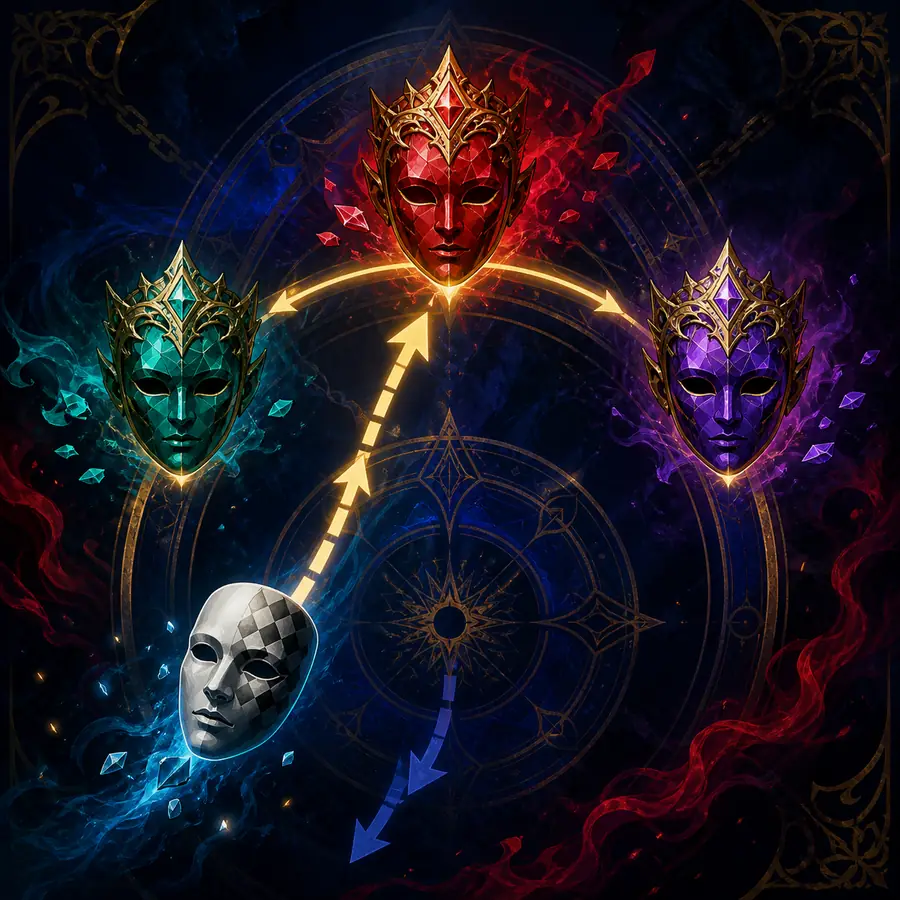
The most important difference between a Treasure Demon and a normal fusion ingredient is the way the result is resolved. The Treasure Demon does not simply behave like an ordinary Arcana pair. Instead, the other Persona's Arcana remains the frame of the calculation while the Treasure Demon moves the result through that Arcana's rank table.
That is why a Treasure Demon fusion chart should be read as a direction aid rather than a full recipe list. You still need the other Persona, its level or rank position, the installed DLC state, and the exact local target records before you can trust a result. The calculator is the right place to test that complete combination.
For example, putting a Treasure Demon beside a low-level Emperor Persona is not the same question as fusing two Emperor Persona. The Treasure Demon can shift the other record to a different point in its Arcana. The practical lesson is simple: identify the partner first, then inspect the result instead of memorizing a generic rule such as always up one rank or always down one rank.
Choose the right reference for each question
| Question | Use first | Why |
|---|---|---|
| Which Arcana direction is possible? | Fusion Chart | It explains the ordinary Arcana relationship before the special shift is applied. |
| What exact Persona will these two records create? | Fusion Calculator | It can account for the selected partner, levels, DLC options, and local data. |
| What does a specific Treasure Demon provide? | This page | The list keeps weakness, rank context, and item outputs together. |
| What happens after itemization? | Itemize List | Normal and Fusion Alarm outputs belong to the itemization lookup. |
Practical route
4. The safest Treasure Demon planning workflow
Start with the reason you are touching the Treasure Demon. A player who wants an early compendium entry needs a different route from a player who is testing a late-game itemization result. Writing that reason down prevents the common error of treating every rare Persona as automatically valuable.
Next, check the partner Persona rather than searching only for the Treasure Demon name. The partner determines the relevant Arcana context and may introduce a DLC, level, special-fusion, or registration constraint. If you already have the partner, use the recipe generator or the calculator's ingredient mode. If you are still choosing a target, use the Persona list first.
Finally, register before committing to a path that is expensive or difficult to repeat. The Treasure Demon list tells you what the local data knows; the calculator tells you what your selected inputs produce. Those are complementary jobs, and keeping them separate makes troubleshooting much faster.
Five checks before you commit
- Record the Treasure Demon name, level, Arcana, and weakness from the table.
- Choose whether the goal is recruit, compendium registration, rank-shift fusion, or itemization.
- Check the partner Persona in the Persona List and confirm its level, Arcana, and special or DLC flag.
- Run the exact combination in the Fusion Calculator; use the Fusion Guide if the result differs from an outside example.
- Compare the resulting Persona or item against the Traits Guide, Skill List, and Itemize List before spending money.
Limits
5. Common mistakes and edition limits
The first mistake is mixing game editions or games. Search results for Treasure Demons often blend Persona 5, Persona 5 Royal, Persona 5 Strikers, and community shorthand. A page can use the same enemy name while describing a different encounter, reward, or location system. This guide keeps the scope on Persona 5 Royal and labels the list as local repository data.
The second mistake is treating a current area note as a guarantee for every save. Palace progression, Mementos progress, late-game access, and data revisions can change how a player reaches a target. When the local record has no area or floor, the honest answer is that this page cannot verify that field. It is better to open the game and confirm than to fill the gap with a guessed location.
DLC changes can affect the surrounding fusion route even when the Treasure Demon's own name remains the same. A partner Persona may be available, unavailable, or resolved differently depending on the calculator settings. Set DLC ownership before trusting an exact result, and do not copy a route from a guide that assumes a different save.
Quick troubleshooting table
| Problem | Likely reason | Next action |
|---|---|---|
| The listed weakness does not match the attack result | Wrong Treasure Demon name, element order, or game guide | Recheck the name and use the local table before comparing other pages. |
| The fusion result is not the expected Persona | Treasure Demon rank shift, partner level, or DLC setting | Run the partner and DLC inputs in the calculator; read the general rules in the Fusion Guide. |
| The area or floor is missing | The local record has no location field | Treat the field as unverified and check the current in-game route. |
| The item output looks different from another table | Normal and Fusion Alarm outputs were mixed | Open the Itemize List and compare the normal and Alarm columns separately. |
Next step
6. When to leave this page for another tool
This page is a reference layer, not a replacement for the site's working tools. Stay here when you need the complete Treasure Demon list, a weakness lookup, a quick location note, or an explanation of why the fusion behaves differently.
Move to the calculator as soon as you know the partner Persona and the target you want. Move to the Fusion Chart when the Arcana relationship is unclear. Move to the Itemize List when the purpose is a weapon, armor, accessory, or skill-card result. Move to the Gallows Guide when the Persona already exists and you are strengthening it rather than creating it.
That division also protects the page from a common SEO and usability problem: one long list cannot answer every downstream question well. A Treasure Demon page should be fast to scan, while a calculator should be interactive and a skill or itemization page should remain searchable by its own entity.
Use this page as the handoff point
- List or weakness lookup: stay on this page.
- Exact Treasure Demon plus partner result: open the Fusion Calculator.
- Arcana direction: open the Fusion Chart.
- Item or Fusion Alarm result: open the Itemize List.
- Existing Persona strengthening or Lockdown context: open the Gallows Guide.
FAQ
Persona 5 Royal Treasure Demons FAQ
How many Treasure Demons are in Persona 5 Royal?
The local Persona 5 Royal data lists nine: Regent, Queen's Necklace, Stone of Scone, Orlov, Emperor's Amulet, Hope Diamond, Crystal Skull, Koh-i-Noor, and Orichalcum. Use the table for their level, Arcana, weakness, area note, and item outputs.
What is the weakness of a Treasure Demon in Persona 5 Royal?
It depends on the named Treasure Demon. The local table lists Nuclear for Regent, Psychic for Queen's Necklace, Fire for Stone of Scone, Gun for Koh-i-Noor, Curse for Orlov, Electric for Emperor's Amulet, Ice for Hope Diamond, Wind for Crystal Skull, and Bless for Orichalcum.
Can you fuse a Treasure Demon in Persona 5 Royal?
Yes, but the result follows a Treasure Demon rank-shift rule rather than ordinary two-Persona Arcana resolution. Select the partner Persona and your DLC settings in the Fusion Calculator instead of relying on a generic chart.
What should I do with a Treasure Demon after the battle?
Choose based on your goal: recruit or register it for the compendium, use it with a partner for a rank-shift fusion, or reserve it for an itemization plan. If you are unsure, register it before experimenting and check the relevant tool page.
Are Persona 5 Royal Treasure Demon locations the same as Persona 5 Strikers?
Do not assume they are the same. Search results often mix the two games, and a public Treasure Demon page may describe Strikers instead of Royal. This guide scopes its table to the local Persona 5 Royal records and marks missing location fields as unverified.
Where can I check the exact Treasure Demon fusion result?
Use the site's Persona 5 Royal Fusion Calculator after selecting the Treasure Demon, partner Persona, and DLC settings. Use the Fusion Chart for Arcana direction and this page for the Treasure Demon list and weakness lookup.
Sources and data notes
How the list was checked
Levels, Arcana, weaknesses, area or floor notes, and item outputs come from this site's local P5R personaMap and element order. Official and store pages are linked for game identification; they do not replace the local data table. A public guide with a matching title was excluded when its page was for Persona 5 Strikers rather than Persona 5 Royal.